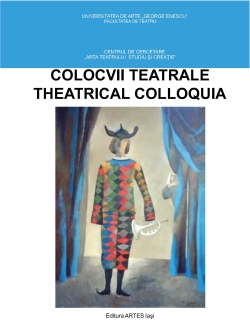
Revista Colocvii Teatrale este publicată sub egida Editurii Artes şi a Centrului de Cercetare “Arta Teatrului Studiu şi Creaţie” şi are o apariţie bianuală. Primul număr a apărut în anul 2004.
Suntem înregistrați cu ISSN 2285 – 5912 și ISSN-L 1584 – 4927(online).
Este recunoscută CNCS, încadrată în categoria B (2021-2020) și în ategoria C (din 2021) și este inclusă în baze de date internaționale precum Erih+, EBSCO, ICI Journals Master List și CEEOL. Cuprinde studii şi articole bilingve, recenzii de carte de specialitate şi cronici teatrale, ceea ce face ca această revistă să constituie un bun instrument de informare pentru cercetătorii, cadrele didactice, studenţii sau profesioniştii din domeniul artelor spectacolului - sau domenii conexe.
Publicarea este condiţionată de îndeplinirea criteriilor cuprinse în scrisorile de anunţ ale fiecărui număr referitoare la temă şi standardele de tehnoredactare, dar și de respectarea standardelor impuse de legislația în vigoare, cu privire la etica cercetării.
Revista este distribuită prin schimburi interbibliotecare directe. Este accesibilă, gratuit, în format online.
FACULTATEA DE TEATRU
Universitatea Națională de Arte „George Enescu”
COLECTIVUL DE REDACŢIE:
- Prof. univ. dr. habil. Anca Ciobotaru - Redactor coordonator - UNAGE Iaşi (download CV)
- Conf. univ. dr. Ioana Petcu - secretar de redacţie - UNAGE Iaşi (download CV)
- Lect. univ. dr. Tamara Constantinescu - redactor – UNAGE Iaşi (download CV)
- Lect. univ. dr. Carmen Antochi - tehnoredactare şi tipărire - Editura Artes (download CV)
- drd. Ioana Soreanu – UNAGE Iaşi
- drd. Cezara Fantu – UNAGE Iaşi
PEER VIEWERS & REFERENȚI:
- Prof.univ.dr.Paulo Balardim – Universitatea de Stat din Santa Catarina, Brazilia
- Irina Niculescu – UNIMA Professional Training Commission,vicepreședinte al UNIMA, USA
- Conf.univ.dr. Nic Ularu – Departamentul de Teatru şi Dans al Universităţii din Carolina de Sud – SUA
- Conf.univ.dr. Andreas Englhart Departmentul de Stiinţe ale Artei al Universităţii din Munich
- Matei Vişniec - RFI - Franţa
- Prof.univ.dr. Angelina Roșca - Universitatea de Muzică, Teatru și Arte Plastice din Chișinău, Republica Moldova
- Prof.univ.dr. Daniela Vitcu – Departamentul de Teatru, Universitatea Ovidius din Constanța
- Conf.univ.dr. Mihaela Beţiu – UNATC, București, Romania
- Lect.univ.dr. Diana Nechit – Departamentul de Artă Teatrală, Facultatea de Litere, USLB Sibiu
- Lect.univ.dr. Alexandra Chiriac – Departamentul de Germanistică, Facultatea de Litere, UAIC Iasi
- Lect.univ.dr. Haricleea Nicolau – Departamentul de Arte, Facultatea de Litere, Universitatea din Craiova
- Conf.univ.dr. Ioana Bujoreanu – UNAGE Iaşi
- Cristina Rusiecki – critic de teatru
- Prof. Univ dr. Anca Maria Rusu
MEMBRI FONDATORI:
- Prof. univ. dr. Natalia Dănăilă
- Dr. Oprea Ştefan – critic de teatru
- Prof. univ. dr. Constantin Paiu – critic de teatru
- Prof. univ. dr. habil. Anca Ciobotaru
ANUNȚURI:
- Anunț nr. 13
- Anunț nr. 14
- Anunț nr. 15
- Anunț nr. 16
- Anunț nr. 17
- Anunț nr. 18
- Anunț nr. 19
- Anunț nr. 20
- Anunț nr. 21
- Anunț nr. 22
- Anunț nr. 23
- Anunț nr. 24
- Anunț nr. 25
- Anunț nr. 26
- Anunț nr. 27
- Anunț nr. 28
- Anunț nr. 29
- Anunț nr. 30
- Anunț nr. 31
- Anunț nr. 32
- Anunț vol. XII ed. 1
- Anunț vol. XII ed. 2
- Anunț vol. XIII ed. 1
- Anunț vol. XIII ed. 2
- Anunț vol. XIV ed. 1
- Anunț vol. XIV ed. 2
- Anunț vol. XV ed. 1
- Anunț vol. XV ed. 2
- Anunț vol. XVI ed. 1
CUPRINS REVISTE
- Cuprins Revista Nr.1
- Cuprins Revista Nr.2
- Cuprins Revista Nr.3
- Cuprins Revista Nr.4
- Cuprins Revista Nr.5
- Cuprins Revista Nr.6
- Cuprins Revista Nr.7
- Cuprins Revista Nr.8
- Cuprins Revista Nr.9
- Cuprins Revista Nr.10
- Cuprins Revista Nr.11
- Cuprins Revista Nr.12
- Cuprins Revista Nr.13
- Cuprins Revista Nr.14
- Cuprins Revista Nr.15
- Cuprins Revista Nr.16
- Cuprins Revista Nr.17
- Cuprins Revista Nr.18
- Cuprins Revista Nr.20
- Cuprins Revista Nr.21
- Cuprins Revista Nr.22
- Cuprins Revista Nr.23
- Cuprins Revista Nr.24
- Cuprins Revista Nr.25
- Cuprins Revista Nr.26
- Cuprins Revista Nr.27
- Cuprins Revista Nr.28
- Cuprins Revista Nr.29
- Cuprins Revista Nr.30
- Cuprins Revista Nr.31
- Cuprins Revista Nr.32
- Cuprins Revista vol XII nr 1
- Cuprins Revista vol XII nr 2
- Cuprins Revista vol XIII nr 1
- Cuprins Revista vol XIII nr 2
- Cuprins Revista vol XIV nr 1
- Cuprins Revista vol XIV nr 2
- Cuprins Revista vol XV nr 1
- Cuprins Revista vol XV nr 2
REZUMAT REVISTE
- Rezumat Revista Nr.13
- Rezumat Revista Nr.14
- Rezumat Revista Nr.15
- Rezumat Revista Nr.16
- Rezumat Revista Nr.17
- Rezumat Revista Nr.18
- Rezumat Revista Nr.21
- Rezumat Revista Nr.22
- Rezumat Revista Nr.23
- Rezumat Revista Nr.24
- Rezumat Revista Nr.25
- Rezumat Revista Nr.26
- Rezumat Revista Nr.27
- Rezumat Revista Nr.28
- Rezumat Revista Nr.29
- Rezumat Revista Nr.30
- Rezumat Revista Nr.31
- Rezumat Revista Nr.32
- Rezumat Revista vol XII nr 1
- Rezumat Revista vol XII nr 2
- Rezumat Revista vol XIII nr 1
- Rezumat Revista vol XIII nr 2
- Rezumat Revista vol XIV nr 1
- Rezumat Revista vol XIV nr 2
- Rezumat Revista vol XV nr 1
- Rezumat Revista vol XV nr 2
DESCĂRCARE REVISTE
- Descărcare Revista Nr.6
- Descărcare Revista Nr.7
- Descărcare Revista Nr.8
- Descărcare Revista Nr.9
- Descărcare Revista Nr.10
- Descărcare Revista Nr.11
- Descărcare Revista Nr.12
- Descărcare Revista Nr.13
- Descărcare Revista Nr.14
- Descărcare Revista Nr.15
- Descărcare Revista Nr.16
- Descărcare Revista Nr.17
- Descărcare Revista Nr.18
- Descărcare Revista Nr.19
- Descărcare Revista Nr.20
- Descărcare Revista Nr.21
- Descărcare Revista Nr.22
- Descărcare Revista Nr.23
- Descărcare Revista Nr.24
- Descărcare Revista Nr.25
- Descărcare Revista Nr.26
- Descărcare Revista Nr.27
- Descărcare Revista Nr.28
- Descărcare Revista Nr.29
- Descărcare Revista Nr.30
- Descărcare Revista Nr.31
- Descărcare Revista Nr.32
- Descărcare Revista vol XII nr 1
- Descărcare Revista vol XII nr 2
- Descărcare Revista vol XIII nr 1
- Descărcare Revista vol XIII nr 2
- Descărcare Revista vol XIV nr 1
- Descărcare Revista vol XIV nr 2
- Descărcare Revista vol XV nr 1
- Descărcare Revista vol XV nr 2
Procesul de peer-review
În vederea publicării articolelor fie în volumul print al revistei, fie prin încărcarea lor în bazele de date internaționale, articolele sunt analizate prin procesul de Peer Review "in dublu orb" (”double blind”), conform procedurilor operaţionale interne. În cadrul procesului de selecţie, numele autorului nu este cunoscut – fiind înlocuit cu un număr de identificare, astfel încât procesul să fie unul obiectiv. Nici numele recenzentului nu e cunoscut de către autor.Rata de refuz al articolelor este de 20%Rapoartele de peer-review sunt întocmite de către Comitetului de Referenţi şi alţi membri ai colectivului de redacţie. Durata procesului este de trei până la cinci săptămâni, iar răspunsurile pot fi „articol acceptat”, „articol acceptat cu modificări cerute autorilor” sau „articol refuzat”.
Reguli de etică şi malpraxis
Studiile trimise pentru publicare, care nu corespund exigenţelor ştiinţifice ale Comitetului de Referenţi şi care nu respectă normele redacţionale stabilite de Colectivului de Redacţie, nu vor fi acceptate. În conformitate cu prevederile legale în vigoare, respingem şi combatem articolele plagiate. Un alt criteriu al selecției este cel al originalității textelor. Un articol este respins, pentru încălcarea caracterului etic, și dacă este publicat în paralel în alte reviste sau dacă a fost prezentat anterior în alte conferințe. Obligaţia corecturii materialelor şi a respectării reglementărilor de tehnoredactare şi aplicare a prevederilor Legii drepturilor de autor revin autorilor. Dacă un autor , atâta vreme cât articolul se află în procesul de peer-review, își dă seama că a comis o eroare, trebuie să contacteze editorii Conferinței sau ai publicației.Pe parcursul procesului de recenzare, editorii și referenții păstrează confidențialitatea informațiilor și a datelor autorului.Modul în care autorii articolelor şi studiilor respectă prevederile Legislaţiei drepturilor de autor, Legii 199/2023 şi Regulamentele interne privind activitatea de cercetare şi creaţie artistică pot fi verificate şi prin utilizarea programului de verificare a plagiatului acreditat de către Ministerul de resort (şi CNCIS). Autorul fiecărui articol trebuie să trimită redacţiei o prezentare succintă a activităţii de cercetare şi creaţie, a aparteneţei instituţionale.
Lista responsabililor cu elaborarea, verificarea şi aprobarea procedurii operaţionale.
- Professor Ph.D. Paulo Balardim - Universidade do Estado de Santa Catarina – Brazil
- Irina Niculescu - UNIMA Professional Training Commission, former vice-president of UNIMA, USA
- Associate Professor Ph.D. Nic Ularu – University of South Carolina, The Department of Theatre and Dance – USA (download CV)
- Associate Professor Ph.D. Andreas Englhart - Department of Art Sciences University of Munich
- Matei Vişniec - RFI - FRANCE
- Professor Ph.D. Angelina Roșca - Academy of Music, Theatre and Fine Arts of Chișinău, Republic of Moldova
- Professor Ph.D. Daniela Vitcu - Drama Department, Ovidius University of Constanța
- Associate Professor PhD. Mihaela Beţiu, I. L. Caragiale National University of Theatre and Film, București, Romania
- Lecturer PhD. Diana Nechit, Department of Theatre Arts Faculty of Letters and Arts, Lucian Blaga University of Sibiu
- Lecturer PhD. Alexandra Chiriac, Department of Germanic Studies, Faculty of Letters, Al. I. Cuza University of Iasi (download CV)
- Lecturer PhD. Haricleea Nicolau, Arts Department, Faculty of Letters, University of Craiova
- Associate Professor PhD. Ioana Bujoreanu - Faculty of Drama, UNAGE, Iasi
- Cristina Rusiecki – critic de teatru
- Prof. Univ dr. Anca Maria Rusu
Lista cuprinzând persoanele la care se difuzează ediţia sau, după caz, revizia din cadrul ediţiei procedurii operaţionale.
| Scopul difuzării | Nr. exemplare | Compartiment | Funcția | Nume și prenume | Data primirii |
| Aplicare | 1 | Facultatea de Teatru | Decan Director Departament Teatru | Prof. univ. dr. Raluca Bujoreanu-Hutanu Conf. univ. dr. Anca Mihaela Ciofu | 01.10.2012 |
| Aplicare | 1 | Universitățile de profil | Directori Centre de Cercetare Biblioteci | - | 01.10.2012 |
Scopul procedurii operaţionale
- Stabileşte modul de realizare a activităţii, structurile şi persoanele implicate;
- Dă asigurări cu privire la existenţa documentaţiei adecvate derulării activităţii;
- Asigură continuitatea activităţii, inclusiv în condiţii de fluctuaţie a personalului implicat.
Domeniul de aplicare a procedurii operaţionale
Reglementează documentaţia de stabilire a modalităţilor de tehnoredactare, primire, selectare şi publicare a studiilor, articolelor şi cronicilor cuprinse în revista COLOCVII TEATRALE.
Documente de referinţă:
Definiţii şi abrevieri ale termenilor utilizaţi în procedura operaţională
Definiţii ale termenilor |
|
| Termenul | Definiţa şi/sau, dacă este cazul, actul care defineşte termenul |
| Procedura operaţională | Prezentarea formalizată, în scris, a tuturor paşilor ce trebuie urmaţi, a metodelor de lucru stabilite şi a regulilor de aplicat în vederea realizării activităţii, cu privire la aspectul procesual |
| Ediţie a unei proceduri operaţionale | Forma iniţială sau actualizată, după caz, a unei proceduri operaţionale, aprobată şi difuzată |
| Revizia în cadrul unei ediţii | Acţiunile de modificare, adăugare, suprimare sau altele asemenea, după caz, a uneia sau a mai multor componente ale unei ediţii a procedurii operaţionale, acţiuni care au fost aprobate şi difuzate |
Abrevieri ale termenilor | |
| Abrevierea | Termenul Abreviat |
| E | Elaborare |
| C | Contribuție |
| V | Verificare |
| A | Aprobare |
| Ap. | Aplicare |
| Ah. | Arhivare |
Descrierea procedurii operaţionale
Generalități:
Misiunea Universităţii Naționale de Arte „George Enescu" din Iaşi, cu îndelungată tradiţie şi prestigiu între şcolile vocaţionale, este de a modela şi cultiva talente, caractere şi personalităţi pentru o Românie în dezvoltare şi de a forma specialişti bine pregătiţi, capabili să ofere publicului larg un act cultural de calitate, concomitent cu o susţinută activitate de creaţie artistică şi cercetare, care să asigure progresul artei şi culturii româneşti.
Autonomia universitară constă în dreptul Universităţii de a se conduce, de a-şi exercita libertăţile academice fără niciun fel de ingerinţe ideologice, politice sau religioase, de a-şi asuma un ansamblu de competenţe, obligaţii şi responsabilităţi în concordanţă cu opţiunile şi orientările strategice naţionale ale dezvoltării învăţământului superior, cu progresul artei şi ştiinţei, al civilizaţiei şi culturii româneşti şi universale şi în conformitate cu obiectivele strategice proprii.
Autonomia Universităţii Nașionale de Arte „George Enescu" din Iaşi se materializează în: autonomia didactică, artistică şi ştiinţifică, autonomia organizatorică şi funcţională, autonomia administrativă şi financiară.
Reglementarea competenţelor decizionale la nivel de Universitate, facultăţi, departamente şi centre de creaţie artistică şi cercetare se face de către Senat, pe baza legislaţiei existente şi a prezentei Charte.
Asigurarea calităţii activităţilor din Universitatea Națională de Arte „George Enescu" din Iaşi este reglementată, în condiţiile autonomiei universitare, prin Regulamente aprobate de e Senatul universitar.
Descrierea procedurii operaţionale
Descrierea procedurii de lucru:
Colectivul de redacţie al revistei aprobă în Şedinţele de Redacţie tema numărului ce urmează a fi publicat. Membrii ce nu pot fi prezenţi sunt consultaţi, de către redactorul coordonator, prin e-mail.
Macheta revistei este realizată în cadrul unei şedinţe operative a colectivului de redacţie.
Tirajul este aprobat, în urma solicitării, în scris, efectuate de către redactorul coordonator.
Aprobarea poartă apostila: Directorului de Departament, Decanului, Rectorului instituţiei.
Anunţul temei este realizat de către secretarul redacţiei. Scrisoarea de anunţ cuprinde, de asemenea, referiri la condiţiile de tehnoredactare şi termenul limită de trimitere al materialelor, în vederea selecţionării şi publicării.
Materialele primite, ce întrunesc condiţiile de publicare solicitate, dar nepublicate vor fi reprogramate pentru un număr ulterior. Autorii vor fi înştiinţaţi cu privire la acest aspect.
Transmiterea materialului către colectivul de redacţie, echivalează cu cedarea drepturilor de autor în favoarea revistei COLOCVII TEATRLE.
Obligaţia corecturii materialelor şi a respectării reglementărilor de tehnoredactare şi aplicare a prevederilor Legii drepturilor de autor revin autorilor.
Selectarea materialelor se face de către colectivul de redacţie, în cadrul unei şedinţe; sunt analizate toate materialele primite pe adresa redacţiei.
Forma finală a revistei rezultă în urma întocmirii rapoartelelor de peer-review, de către Comitetului de Referenţi şi alţi membri ai colectivului de redacţie. În cadrul procesului de selecţie, numele autorului nu este cunoscut – fiind înlocuit cu un număr de identificare, astfel încât procesul să fie unul obiectiv.
Modul în care autorii articolelor şi studiilor respectă prevederile Legislaţiei drepturilor de autor, Legii 199/2023 şi Regulamentele interne privind activitatea de cercetare şi creaţie artistică pot fi verificate şi prin utilizarea programului de verificare a plagiatului acreditat de către Ministerul de resort (şi CNCIS).
Descrierea procedurii operaţionale
Matricea responsabilitǎţilor:
| Acţiunea / operaţiunea | Responsabil | I | II | III | IV | V | VI | VII |
| Stabilirea temei numărului | Colectivul de redacţie | E | ||||||
| Stabilirea tirajului Întocmirea referatului | Redactor coordonator | C | ||||||
| Realizarea şi transmiterea scrisorii de anunţ | Secretarul redacţiei Redactorul coordinator | C | V | |||||
| Intocmirea Referatelor de îndeplinire a obligaţiilor didactice | Şef Departament | E | ||||||
| Aprobarea Referatelor de tipărire | Director Departament Decan Rector | A | ||||||
| Transmiterea materialelor, în vederea publicării | Autorii | Ap. | ||||||
| Arhivarea conţinuturilor publicate | Tehnoredactor tipografia editurii Artes | Ah. |
Descrierea procedurii operaţionale
Dispoziţii finale:
Autorilor le revin, în principal, urmǎtoarele obligaţii:
- obligaţia de a realiza, tehnoredacta, în formatul solicitat, traduce într-o limbă de dirculaţie internaţională şi corecta materialele prezentate;
- obligaţia de a respecta prevederii Legii drepturilor de autor;
- obligaţia de a respecta prevederile cuprinse în Scrisoarea de anunţ;
- alte obligaţii prevăzute de lege sau de Charta UNAGE.
Colectivul de redacţie are, în principal, urmǎtoarele drepturi:
- sǎ stabileascǎ tema şi condiţiile de tehnoredactare;
- să stabilească atribuţiile corespunzătoare fiecărui membru;
- sǎ exercite controlul asupra modului de îndeplinire a condiţiilor de publicare;
- să stabilească obiectivele de performanţă, precum şi criteriile de evaluare a realizării acestora ; normele de comportare sunt stabilite fǎrǎ a aduce atingere dreptului la opinie, libertǎţii exprimǎrii şi libertǎţii academice.
Orice act normativ apărut ulterior care face referire la prezenta procedură conduce, dacă este cazul, la modificarea acesteia.
Facultatea de Teatru
Secretariat:
Str. Costache Negruzzi nr. 7 - 9, Iaşi 700126, România
Telefon: 0040 - 232 - 212548
Fax: 0040 - 232 - 216637
Contact revista:
Editura si Tipografia „Artes” nu au personalitate juridica, ele apartin de Universitatea Națională de Arte „George Enescu” Iași
The Theatrical Colloquia journal is edited by Artes Publishing House and The Research Centre “The Art of Theatre – Study and Creation”, in one issue per semester. The first issue was released in 2004.
We are rgistred with a print ISSN 2285 – 5912 and ISSN-L 1584 – 4927(online).
It is CNCS recognized, classified in category B (2021-2020) and in category C (from 2021) and is included in international databases such as Erih+, EBSCO, ICI Journals Master List and CEEOL. It includes bilingual studies and articles, specialized book reviews and theater reviews, which makes this magazine a good information tool for researchers, teachers, students or professionals in the field of performing arts - or related fields.
Theatrical Colloquia is covered by the following services:
- Baidu Scholar
- CNKI Scholar (China National Knowledge Infrastructure)
- CNPIEC - cnpLINKer
- Dimensions
- EBSCO (relevant databases)
- EBSCO Discovery Service
- Google Scholar
- J-Gate
- JournalTOCs
- KESLI-NDSL (Korean National Discovery for Science Leaders)
- MLA International Bibliography
- MyScienceWork
- Naviga (Softweco)
- Primo Central (ExLibris)
- ProQuest (relevant databases)
- Publons
- QOAM (Quality Open Access Market)
- ReadCube
- Summon (ProQuest)
- TDNet
- Ulrich's Periodicals Directory/ulrichsweb
- WanFang Data
- WorldCat (OCLC)
The journal consists of bilingual studies and articles, reviews of specialized books and dramatic productions, which makes this journal a useful means of information for researchers, professors, students or artists in the field of theatre – or connected domains of expertise. All articles are given a DOI number.
Publication is conditional on meeting the criteria contained in the announcement letters of each issue regarding the theme and technical editing standards, but also on compliance with the standards imposed by the legislation in force regarding research ethics.
The magazine is distributed through direct interlibrary exchange through orders on the publisher's website. It is accessible, free of charge, in online format.
THE FACULTY OF THEATRE
George Enescu National University of Arts, Iaşi
EDITORIAL STAFF:
- Professor, PhD habil. Anca Ciobotaru - Editor in chief - UNAGE Iaşi (download CV)
- Associate Professor PhD. Ioana Petcu, PhD - Editorial Secretary - UNAGE Iaşi (download CV)
- Lecturer PhD.Tamara Constantinescu, PhD - Editor – UNAGE Iaşi
- Lecturer PhD.Carmen Antochi - Desktop publishing and printing – Artes Publishing House
- PhD. candidate Ioana Soreanu – UNAGE Iaşi
- PhD. candidate Cezara Fantu – UNAGE Iaşi
PEER REVIEW:
- Professor Ph.D. Paulo Balardim - Universidade do Estado de Santa Catarina – Brazil
- Irina Niculescu - UNIMA Professional Training Commission, former vice-president of UNIMA, USA
- Associate Professor Ph.D. Nic Ularu – University of South Carolina, The Department of Theatre and Dance – USA (download CV)
- Associate Professor Ph.D. Andreas Englhart - Department of Art Sciences University of Munich
- Matei Vişniec - RFI - FRANCE
- Professor Ph.D. Angelina Roșca - Academy of Music, Theatre and Fine Arts of Chișinău, Republic of Moldova
- Professor Ph.D. Daniela Vitcu - Drama Department, Ovidius University of Constanța
- Associate Professor PhD. Mihaela Beţiu, I. L. Caragiale National University of Theatre and Film, București, Romania
- Lecturer PhD. Diana Nechit, Department of Theatre Arts Faculty of Letters and Arts, Lucian Blaga University of Sibiu
- Lecturer PhD. Alexandra Chiriac, Department of Germanic Studies, Faculty of Letters, Al. I. Cuza University of Iasi (download CV)
- Lecturer PhD. Haricleea Nicolau, Arts Department, Faculty of Letters, University of Craiova
- Associate Professor PhD. Ioana Bujoreanu - Faculty of Drama, UNAGE, Iasi
- Cristina Rusiecki – theatre critic
- Professor Anca Maria Rusu, PhD
FOUNDING MEMBERS:
- Professor Natalia Dănăilă, PhD
- Ştefan Oprea, PhD – theatre critic
- Professor Constantin Paiu, PhD – theatre critic
- Professor, PhD habil. Anca Ciobotaru
CALL FOR PAPERS:
- Call no. 13
- Call no. 14
- Call no. 15
- Call no. 16
- Call no. 17
- Call no. 18
- Call no. 19
- Call no. 20
- Call no. 21
- Call no. 22
- Call no. 23
- Call no. 24
- Call no. 25
- Call no. 26
- Call no. 27
- Call no. 28
- Call no. 29
- Call no. 30
- Call no. 31
- Call no. 32
- Call vol. XII issue 1
- Call vol. XII issue 2
- Call vol. XIII issue 1
- Call vol. XIII issue 2
- Call vol. XIV issue 1
- Call vol. XIV issue 2
- Call vol. XV issue 1
- Call vol. XV issue 2
- Call vol. XVI issue 1
CONTENTS
- Contents of No.6
- Contents of No.7
- Contents of No.8
- Contents of No.9
- Contents of No.10
- Contents of No.11
- Contents of No.13
- Contents of No.14
- Contents of No.15
- Contents of No.16
- Contents of No.17
- Contents of No.18
- Contents of No.21
- Contents of No.22
- Contents of No.23
- Contents of No.24
- Contents of No.25
- Contents of No.26
- Contents of No.27
- Contents of No.28
- Contents of No.29
- Contents of No.30
- Contents of No.31
- Contents of No.32
- Contents ofvol XII issue 1
- Contents of vol XII issue 2
- Contents of vol XIII issue 1
- Contents of vol XIII issue 2
- vol XIV issue 1
- Contents of vol XIV issue 2
- Contents of vol XV issue 1
- Contents of vol XV issue 2
ABSTRACTS
- Abstracts No.13
- Abstracts No.14
- Abstracts No.15
- Abstracts No.16
- Abstracts No.17
- Abstracts No.18
- Abstracts No.21
- Abstracts No.22
- Abstracts No.23
- Abstracts No.24
- Abstracts No.25
- Abstracts No.26
- Abstracts No.27
- Abstracts No.28
- Abstracts No.29
- Abstracts No.30
- Abstracts No.31
- Abstracts No.32
- Abstracts vol XII issue 1
- Abstractsvol XII issue 2
- Abstracts vol XIII issue 1
- Abstracts vol XIII issue 2
- Abstracts vol XIV issue 1
- Abstracts vol XIV issue 2
- Abstracts vol XV issue 1
- Abstracts vol XV issue 2
MAGAZINES
- Download No.6
- Download No.7
- Download No.8
- Download No.9
- Download No.10
- Download No.11
- Download No.12
- Download No.13
- Download No.14
- Download No.15
- Download No.16
- Download No.17
- Download No.18
- Download No.19
- Download No.20
- Download No.21
- Download No.22
- Download No.23
- Download No.24
- Download No.25
- Download No.26
- Download No.27
- Download No.28
- Download No.29
- Download No.30
- Download No.31
- Download No.32
- Download Theatrical Colloquia vol 12 issue 1 / 2022
- Download Theatrical Colloquia vol 12 issue 2 / 2022
- Download Theatrical Colloquia vol 13 issue 1 / 2023
- Download Theatrical Colloquia vol 13 issue 2 / 2023
- Download Theatrical Colloquia vol 14 issue 1 / 2024
- Download Theatrical Colloquia vol 14 issue 2 / 2024
- Download Theatrical Colloquia vol 15 issue 1 / 2025
- Download Theatrical Colloquia vol 15 issue 2 / 2025
- Download Theatrical Colloquia vol 16 issue 1 / 2026
- … and All Men and Women Are Critics or Criticism in a Mirage Universe by Kalina STEFANOVA
- The Experience of the Spaces for The Representation and Distances Required for Handling. Looks and Movements of Living Bodies - Puppets - Virtual or Electronic Objects and Bodies by Françoise FLABAT
- Martha Graham, the Ancient Greek Theater and the Rewriting of the Classical Texts through the Bodily Movement on Stage by Camelia LENART
- On Dramaturgy in the Twenty-First Century by Diana COZMA
- Ibsen Face to Face with The New Stage Aesthetics. Radu Afrim and Andriy Zholdak Recreating The Lady From The Sea by Diana NECHIT and Andrei C. ȘERBAN
- Literary and Theatrical Resilience: Quixote, from Classic and (Post)Modern Character, to Syndrome by Ana-Magdalena PETRARU
- Ionesco Obsessions in Scenic Imagery Signed Gábor Tompa by Tamara CONSTANTINESCU
- The Spacing of a Message by Anca-Doina CIOBOTARU and Carmen MIHALACHE
- Emergence and Artificial Intelligence in the Performing Arts by Radu TEAMPĂU
- Severed Green: a Pandemic-Born Structure by Alexandra FELSEGHI
- Theatre in Post-Newtonian Era by Ion MIRCIOAGĂ
- Claus Guth and The Inverted Dioramas by Cristi AVRAM
- The Acting Teachers – The Usual Students by Laura BILIC
- The Metamorphoses of Drama Pedagogy in European Arts High Education Institutions Between Constraint and Initiative by Raluca ZAHARIA
- Breathing and The Voice Practices on Stage by Anca SIMILAR
- Emerging Theatre Practices – The Golden Myth of European Theatrical Thought by Marius Alexandru TEODORESCU
- On Bodies in Motion: New Perspectives in Contemporary Choreography by Andreea NOVAC
- Art as Therapy. Reducing Symptoms of Burnout Syndrome Among Healthcare Personnel in Hospitals by Means of Artistic Interventions by Diana BULUGA
- A Way to a More Immersive Performance Through the Use of Technology by Vlad BENESCU
- On The Verge of a New Fusion: Theatre Space – Digital Space by Alexandra DIACONIȚA
- Theatre as a Public Service. Tendencies and Relevance by George COSTIN
- Scenic aesthetics in Belgium: history of emancipation by Véronique LEMAIRE
- Diversity in universality by Otilia HUZUM
- On pedagogy: between mark/model and the broken mirror by Gelu BADEA
- Creative Profile Outline by Anca Doina CIOBOTARU•
- ”Theatre should be free, like air or love”. Joan Littlewood and the imperative of collective creation by Răzvan MUREȘAN
- Female image from Euripides to Churchill by Alexandra FELSEGHI
- Maeterlinck’s Poetic Symbolism in Trei piese triste (Three Sad Plays) by Ana-Magdalena PETRARU
- The festival - the mark of the city's cultural identity in the context of urban marketing by Ioana-Raluca ZAHARIA
- Identity from a Theatrical Perspective by Radu TEAMPĂU
- The Opera Libretto – Adaptation of A Canonical Literary Text, The Opera ”O Noapte furtunoasă” by Paul Constantinescu by Cristi AVRAM
- Music – main character in theatre productions by Antonella CORNICI
- The importance of meaning in the act of creation by Iulia LUMÂNARE
- “Bonjour, bourgeois” or undermining the realist convention in The Greek Weird Wave by Emanuel-Alexandru VASILIU
- Execution of plies – basis of classical dance technique by Anca IORGA
- The Limits of Film within the Limits of Theatre, in Two Examples Spectacular identities from the Communist and present era by Emanuel Alexandru PÂRVU
- Specific training methods in the art of classical dance by Marian CHIRAZI
- Multiple Spectacular Identities or about variations of artistic forms on the same subject by Stanca Maria BOGDAN
- The actor's dramaturgy: identity, freedom, and discipline by Sorin-Dan BOLDEA
- About theatre with love by Clara GHIUVELICHIAN
- Multiplied illusions by Anca Doina CIOBOTARU and Elena Carmen ANTOCHI
- Slices of Life Mirrored on Stage by Diana COZMA
- Theater between art and experiment by Otilia HUZUM
- Literary and Stage Humour in Three by Ana-Magdalena PETRARU
- The theater - the sensible universe where the unspeakable is made known by Iulia LUMÂNARE
- Scenography, a Special Form of Art and Basic Component of Total Theatre by Răzvan-Petrișor DRAGOȘ
- Time of Theatre or How We Made a Fairy Tale with Auntie Ilonka, the Wild Woman by Kisó Kata PALOCSAY
- The Art of Dance and The Human Body in Motion by Lorette ENACHE
- The actor and his character by Anca IORGA
- Fear and pity: about the tragedy’s resurrection in the post-pandemic era by Alexandra FELSEGHI
- The Merry Widow 2.0. Andrei Șerban by Cristi AVRAM
- Right/Wrong vs. Possiblity/Choice by Laura BILIC
- Methods of professionalization in the performing arts - the high school model by Iulia URSA
- On Theatre-Mirror, Theatre-Hammer, Theatre-Veil in the Romanian Theatre by Radu TEAMPĂU
- Truth and Temporality - Points of Intersection Between Actor and Character by Alexandra DIACONITA
- Theater in a post-literate world by Ioana ILAȘ BODALE
- The Role of Theatre in the Development of the Modern Human by Inga MARCU-REMENTOV
- Caragiale between comic and communism by Alexandru SINCA
- But does snow have meaning? by Cezara-Ștefania SAVA-FANTU
- About the timeless time in theater by Georgeta Simona PANDELE
- A.P. Chekhov A life in letters – Correspondence (1891 – 1904) by Anca Doina CIOBOTARU
- A Theatre of Inquietude by Diana COZMA
- To Be Or Not To Be! by Otilia HUZUM
- The Immanence of Abysmal Seduction in the Art of Acting by Iulia LUMÂNARE
- Maria Blut or On the Lost Charm of Theatricality by Aurelian BĂLĂIȚĂ and Călin CIOBOTARI
- Slava's Snowshow and Existentialism by Octavian JIGHIRGIU and Andreea J. DARIE
- Anxiety and Sublime in Theatre by Radu TEAMPĂU
- Amadeus – Musical Genius in Theater and Film by Ana-Magdalena PETRARU
- The Clown and His Therapeutic Play. Le Rire Médecin by Antonella CORNICI
- Behind the Brain - Epilepsy.Narrative Perspectives by Cristi AVRAM
- Metaphorographic - Performative Experiences In Performances: (In Between) Homes/ Ulysses and Thrill Me : The Story Of Leopold And Loeb by Raluca LUPAN
- Richard Wagner – The Genius Mark Of A Simmering Brew Of Pursuits, Anxieties And Contrasts by Stanca Maria BOGDAN
- Confluences Between Theater and Visual Arts: Van Gogh and Edvard Munch or From Tragedy to Dramaturgy by Aura Evelina RADU
- Personal Perspective through Digital Art in Contemporary Theatre and Performance by Marius-Alexandru TEODORESCU
- The Anxieties of Generation Z. Story of a Hooded Sufferer. Devised theatre - An instrument of connection by Cezara - Ștefania FANTU
- Verbatim Theatre: Anguish and Theatrical Truths by Sorin-Dan BOLDEA
- Involvement and Detachment of the Actor in the Creative Process. Stanislavsky System - Brecht System by Marius BODOCHI
- Race Preparation: A Dialogue with the Past and the Future of Theater Director Pedagogy by Mihai GLIGAN
- The Nature of the „BEAST” by Petre-Gabriel COVEȘANU
- The Eastern Front of the Romanian Language, the Founding Of the Iași National by Alexandru Florin SINCA
- Researches in Maurice Maeterlinck’s Theater Works by Ioana PETCU-PĂDUREAN
- My Puppet, My Freedom! by Albert BAGNO
- Lessons Regarding Liberty by Anca Doina CIOBOTARU
- A Play of the Double by Diana COZMA
- The Actor – The Generator Of Living Narrative Structures And Metaphors by Camelia CURUȚIU-ZOICAȘ
- The stage of the radio theater - new metaphorical space by Dana ENACHE
- Metaphor and Theatre by Radu TEAMPĂU
- Applicability Of Actor's Art Methods In Online And Reality – Three Sisters, A.P. Chekhov by Andrei VIZITIU
- Neuro-Aesthetics – Representing the Mind on Stage by Marius-Alexandru TEODORESCU
- Dance film from Maya Deren to Anne Teresa De Keersmaeker by Emanuel-Alexandru VASILIU
- The limits of freedom: Eu sunt! Și? case by Sorin-Dan BOLDEA
- The metaphor of kitsch in Caragiale's work. A Stormy Night & Company at "Tudor Vianu" Theatre Giurgiu by Cristi AVRAM
- Lonely Lives – A Living Theatrical Metaphor by Ana-Magdalena PETRARU
- Choreography in operetta performances – Case study: The ball of Prince Orlofsky from Die Fledermaus production by Johann Strauss – The Son, act II by Anca IORGA
- Heart In The Bag, Love In The Sack And Hope Still Alive? The Magical Realism Of Playwright John Cariani. Study On The Metaphor In The Text Almost Maine by Oana MOGOȘ
- The Metaphor in movement by Pamela TĂNASĂ-GACHE
- Stage Lighting In Puppetry, A Friend Or An Enemy ? by Ileana OCNEANU
- Theatrical metaphor in a „woke” and „cancel” culture by Adrian-Paul NEDELCUȚĂ
- Cinematic Symbolism: Delving into Metaphor within Film by Olimpia MELINTE
- Reflection and Action in the Actor’s Work by Diana COZMA
- In Search of Alterity by Otilia HUZUM
- The Taming of the (Post)Modern Shrew in Literature and on Stage by Ana-Magdalena PETRARU
- The Intersection of Theatre, Motion Capture, and Digital Avatars Exploring New Horizons in Children's Theatre by Cosmin MATEI
- Jedermann. Medieval Mystery, Towards a Timeless-Contemporary Stage Directing by Alba Simina STANCIU
- Choreography In Operetta Performances – Case Study: The Cabaret Show In Die Csárdásfürstin (Sylva Or The Csárdás Princess), Act I, Production By Emmerich Kalman by Anca IORGA
- The Psychological Gesture in The Theater of Animation - Case Study of the Performance The Butler Directed by Ciprian Huțanu by Ioana PETCU
- Correspondences Between Reflection and Scenic Action by Radu TEAMPĂU
- Structural Developments in The Pedagogy Of The Art of Acting: From Student To Actor in The New Dynamics of Performance Art by Andrei VIZITIU
- Michael Haneke’s Glaciation Trilogy: A Pessimistic Vision of Contemporary European Society by Diana NECHIT, Andrei C. ȘERBAN
- Evocations of the ‘Believable’ on Stage. Mechanisms of Perception by Alexandra DIACONIȚA
- The Traps of Reflection and the Danger of Action by Lorette ENACHE
- Spontaneity as a Catalyst for Inner Change.The Impact of Psychodrama and Drama Therapy by Cezara-Ștefania FANTU
- Shakespeare and Reflecting on Space as an Invitation to Interaction by Ovidiu IVAN
- Affective Memory in Artistic Creation: Tool or Trap? by Lari-Cosmin GIORGESCU
- A Somatic Approach to Contemporary Actor Training by Gabriel HRIȚCU
- Improvisation in the Theatrical Performance: Means of Creativity and Expression by Anca Ofelia MARKOS
- The Return to Storytelling in the Theatre of the Third Millennium by Diana COZMA
- Meyerhold's Biomechanics and Its Importance in the Art of the Actor by Otilia HUZUM
- The Rigors of the Present, the Promise of the Future: Perspectives on the Future of Romanian Theater by Sorin-Dan BOLDEA and Diana ALDEA
- Disrupted Lives in Romanian Drama on the Recent War of Ukraine. Erica Moldovan’s Manichiura rosie/ Red Manicure as a Case in Point by Ana-Magdalena PETRARU
- The Actor Between Discipline and Emotion by Laura BILIC
- “I have a problem in existing without creating, so my solution to exist is to create.” -Dimitris Papaioannou- by Lorette ENACHE
- Queer Performances in Public Theatres in Romania Today. Perspectives of Young Theatre Directors: Catinca Drăgănescu, Eugen Jebeleanu, Leta Popescu by George-Albert COSTEA
- Pedagogy Theater in the Sphere of Amateur Creations by Claudiu DOGARU
- Acting between Rigor and Freedom by Simona PUSTIANU
- Radio Theatre – From the Rigour of Construction, To the Emotion of a “Performance of Sound” by Ioana (SOREANU) ANTONICĂ
- The Evolution Of A Performance Not Only For The Young. The Magic Land At Luceafărul Theatre Of Iași - A Look From Within by Ileana OCNEANU
- Perspectives on Emotion and Stage Action in Acting by Ionuț-Florin NICULAE
- Towards the Creative Self Through Bodily Creativity by Gabriel HRIȚCU
- The Boundaries of Theatrical Freedom: When Symbols Challenge Religion by Alexandra-Sorana EȘANU
- The Actor’s Craft at the Intersection of Emotion and Rigour by Anca Ofelia MARKOS
- The Destiny of Puppets – a necessary story by Anca Doina CIOBOTARU
- Persona. Artistic Research on Acting Processuality within a “Practice-Based Research” Paradigm by Octavian JIGHIRGIU and Andreea JIGHIRGIU
- Actor and Character from the Perspective of Uta Hagen’s Method by Diana COZMA
- Emotion in theatre as abuse, excess and acting technique by Radu TEMPĂU
- Poverty, Courage, and Compromise: Brechtian Dimensions and Modern Directing in Mutter, a Performance by Dumitru Acriș – A study on how Brechtian aesthetics are reinterpreted through contemporary directorial means by Cristina BLAGA-TOMUȘ
- Theater in the United Arab Emirates: Cultural Evolution and Contemporary Practices by Sorin-Dan BOLDEA
- Embodied Expression: Cognition, Technique, and Memory in the Art of the Silent Actor by Pali VECSEI
- The Nameless Star or Chekhov's "Moscow" by Cristi AVRAM
- Costache Antoniu - Actor, Teacher, and Theater Promoter by Carmen ANTOCHI
- The evolution of dance in American musicals by Geta-Violeta RĂVDAN
- Emotion and Absurdity Between Stage and Screen. A Comparison of Theatrical Techniques and Mockumentary Aesthetics in Waiting for Godot and Waiting for Guffman by Mihaela Florentina CONSTANTINESCU
- Dream, Daydream, Memory by Mircea Levente COCIARDI
- The Roma Theatre in Romania: Between Expression and Institutionalization by Alexandra-Ioana MOJOIU
- Tribunal Theatre: Performativity, Memory, and Symbolic Justice by Cristian CĂLBEAZĂ
- Scenic and Dramatic Space in Harold Pinter by Despina G. KOSMOPOULOU
- The Stage as Examination or the Stage as Revelation? Dilemmas of Student Theatre by Ion M. TOMUȘ
- On the Limits of the Actor’s Craft by Diana COZMA
- Identity and Representation in Pakistani Theatre: Khawaja Sira and the Dynamics of Cultural Discourses by Sorin-Dan BOLDEA, Raeem FAROOQ and Alexandru-Octavian CĂLINA
- Dilemma and Theatre by Radu TEAMPĂU
- The Power of Discretion – The Figure Actor by Otilia HUZUM
- Spectacular Dilemmas in Caragiale’s Works and Their Reflections on Stage and in Translation by Ana-Magdalena PETRARU
- Choreography in Operetta Performances. Case Study: The Couplets “How Can One Live Without Love” From the Operetta Die Csárdásfürstin (Silvia or the Csárdás Princess), Act I, Scene 3, By Emmerich Kálmán by Anca IORGA
- The Convergence of Past and Present in the Art of Acting Classes. Reconsidering the Necessity of Pedagogical Models by Andrei VIZITIU
- The Myth of Ovid in Romanian Dramaturgy: Expression of the Dobrogean Space and Spirit by Clara GHIUVELICHIAN
- Live Dissection - A Theatrical Perspective Inspired By The Work Of Aureliu Manea by Lorette ENACHE
- The Same, Always Different. A Look Towards the Adaptation and Translation Phenomena of the Contemporary Stage Productions by Ileana URSU
- Using Dramatherapy to Prevent Student Burnout: Insights and Practical Approaches by Inga MARCU
- Radio Theatre: Theatrical Genre or Hybrid Species? by Ioana SOREANU
The Faculty of Theatre
Secretariat:
9 Costache Negruzzi Street, Iaşi 700126, Romania
Telephone: 0040 - 232 - 212548
Fax: 0040 - 232 - 216637
Contact for the journal:
Artes Publishing and Printing Houses do not have legal personality, they pertain to the George Enescu National University of Arts, Iaşi.
Peer-review process
In order to publish articles in the printed volume of „Theatrical Colloquia”, or to upload them on international databases, they have to be analysed in a “double blind” peer-review process, according to internal operational procedures. During the selection process, the author’s name is not known – being replaced with an identification number, so that the process is an objective one. The author also does not know the name of the reviewer. The article refusal rate is 20%.The peer-review reports are made by the Committee of Reviewers and other members of the editorial board. The process lasts between three and five weeks, and the answers can be: “acceptable for publication without revisions”, “acceptable for publication with minor revisions”, “acceptable for publication with major revisions” or “rejected”.
Ethic rules and malpractice
Studies submitted for publication that do not meet the scientific requirements of the Referees Committee and that do not comply with the editorial rules established by the Editorial Board will not be accepted. In accordance with the legal provisions in force, we reject and combat plagiarized articles. Another selection criterion is the originality of the texts. An article is rejected for ethical violations, even if it is published in parallel in other journals or if it has been previously presented at other conferences. The obligation to correct the materials and to comply with the technical editing regulations and the application of the provisions of the Copyright Law lies with the authors. If an author, while the article is in the peer-review process, realizes that he has made an error, he must contact the editors of the Conference or of the publication.During the review process, editors and referees maintain the confidentiality of the author's information and data. The way in which the authors of articles and studies comply with the provisions of the Copyright Legislation, Law 199/2023 and the Internal Regulations regarding research and artistic creation can also be verified by using the plagiarism checking program accredited by the relevant Ministry (and CNCIS). The author of each article must send the editorial office a brief presentation of the research and creation activity, of the institutional affiliation.
List of those responsible for elaborating, checking and approving the operational procedure
- Professor Ph.D. Paulo Balardim - Universidade do Estado de Santa Catarina – Brazil
- Irina Niculescu - UNIMA Professional Training Commission, former vice-president of UNIMA, USA
- Associate Professor Ph.D. Nic Ularu – University of South Carolina, The Department of Theatre and Dance – USA (download CV)
- Associate Professor Ph.D. Andreas Englhart - Department of Art Sciences University of Munich
- Matei Vişniec - RFI - FRANCE
- Professor Ph.D. Angelina Roșca - Academy of Music, Theatre and Fine Arts of Chișinău, Republic of Moldova
- Professor Ph.D. Daniela Vitcu - Drama Department, Ovidius University of Constanța
- Associate Professor PhD. Mihaela Beţiu, I. L. Caragiale National University of Theatre and Film, București, Romania
- Lecturer PhD. Diana Nechit, Department of Theatre Arts Faculty of Letters and Arts, Lucian Blaga University of Sibiu
- Lecturer PhD. Alexandra Chiriac, Department of Germanic Studies, Faculty of Letters, Al. I. Cuza University of Iasi (download CV)
- Lecturer PhD. Haricleea Nicolau, Arts Department, Faculty of Letters, University of Craiova
- Associate Professor PhD. Ioana Bujoreanu - Faculty of Drama, UNAGE, Iasi
- Cristina Rusiecki – theatre critic
- Professor Anca Maria Rusu, PhD - Faculty of Drama, UNAGE, Iasi
List of people who receive the issue or the revised edition of the operational procedure, where applicable
| Purpose of issuance | Number of copies | Compartment | Function | Name and surname | Date received |
| Application | 1 | The Faculty of Theatre | Dean Head of the Theatre Department |
Professor Raluca Bujoreanu-Huţanu, PhD Associate Professor Anca Mihaela Ciofu, PhD |
10/01/2012 |
| Application | 1 | Profile Universities | Heads of Research Centres Libraries |
- | 10/01/2012 |
Purpose of the operational procedure
- Establishes the way to carry out the activity, the structures and people involved;
- Gives assurance in regard with the existence of the adequate documentation for the fulfilling of the activity;
- Assures the continuity of the activity, even under the circumstances of fluctuation of the staff involved.
Domain of application of the operational procedure
Regulates the documentation for establishing the procedures for desktop publishing, receiving, selecting and publishing the studies, articles and reviews to appear in the journal THEATRICAL COLLOQUIA.
Reference documents:
Definitions and abbreviations of terms used in the operational procedure
Definitions of terms |
|
| Term | Definition and/or, where necessary, the act defining the term |
| Operational procedure | Formal written presentation of all steps to be followed, established working methods and rules to be applied in order to fulfill the activity, regarding its procedural aspect |
| Edition of an operational procedure | Initial or, be it the case, updated version of an approved and issued operational procedure |
| Revision of an edition | Actions of modifying, appending, abridging or others of the sort, of one or, respectively, several components of an edition of the operational procedure, actions that have been approved and issued |
Abbreviations of terms | |
| Abbreviation | Abbreviated term |
| E | Elaboration |
| C | Contribution |
| V | Verifying |
| A | Approving |
| Ap. | Application |
| Ah. | Archiving |
Description of the operational procedure
Generalities:
The mission of the George Enescu National University of Arts of Iaşi, with a longstanding tradition and prestige among vocational education institutions, is to form and nourish talent, character and personalities for a developing Romania and also to breed highly trained specialists who are capable of presenting the wide audience with a cultural act of quality, alongside a sustained activity in the area of artistic creation and research, meant to ensure the progress of Romanian art and culture.
The university’s autonomy resides in its right to rule itself, to exercise its academic liberties without any ideological, political or religious interference, to assume an assembly of competences, obligations and responsibilities according to the national strategic options and directions of development of higher education, to the progress of art and science, of Romanian civilization and culture and to its own strategic objectives.
The autonomy of George Enescu National University of Arts of Iaşi takes the shapes of: educational, artistic and scientific autonomy, organizational and functional autonomy, administrative and financial autonomy.
The regulation of decisional competences for the University, faculties, departments and centres of artistic creation and research is done by the Senate, using the existent legislation and the present Charter.
The assurance of the quality of activities held by George Enescu National University of Arts of Iaşi is brought under Regulations approved by the University’s Senate, under the terms of University autonomy.
Description of the operational procedure
Description of the working procedure:
The editorial team of the journal approves the theme of the issue to be published in the Editorial Meetings. Members who cannot be present are consulted by the coordinating editor via e-mail.
The layout of the journal is created during an operational meeting of the editorial team.
The circulation is approved, following a written request made by the coordinating editor or by the secretary, depending on the requests and financial resources.
The approval bears the apostille of: the Director of the Department, the Dean, the Rector of the institution.
The announcement of the theme is made by the secretary of the editorial office. The announcement letter also includes references to the technical editing conditions and the deadline for sending materials, for selection and publication.
Materials received that meet the requested publication conditions, but not published, will be rescheduled for a subsequent issue. The authors will be notified of this.
Sending the material to the editorial team is equivalent to the assignment of copyright in favor of the Theatrical Colloquia journal.
The obligation to proofread the materials and to comply with the technical editing regulations and the application of the provisions of the Copyright Law rests with the authors.
The selection of materials is made by the editorial team, during a meeting; all materials received at the editorial office are analyzed.
The final form of the magazine results from the preparation of peer-review reports, by the Referents Committee and/or other members of the editorial team. During the selection process, the author's name is not known - being replaced with an identification number, so that the process is objective.
The way in which the authors of articles and studies comply with the provisions of the Copyright Legislation, Law 199/2023 and the Internal Regulations regarding research and artistic creation can also be verified by using the plagiarism checking program accredited by the relevant Ministry (and CNCIS).
Description of the operational procedure
Table of responsibilities:
| Action/operation | Responsible | I | II | III | IV | V | VI | VII |
| Establishing the issue’s subject | The editorial staff | E | ||||||
| Establishing the number of issues Writing the report | The editor in chief | C | ||||||
| Writing and sending the announcement letter | The editorial secretary The editor in chief | C | V | |||||
| Writing the Reports of fulfillment of didactic activities | The Head of the Department | E | ||||||
| Approving the Report for publishing | The Head of the Department The Dean The Rector | A | ||||||
| Sending materials for publishing | The authors | Ap. | ||||||
| Archiving published content | Editor of the ARTES Publishing House | Ah. |
Description of the operational procedure
Final settlements:
The authors mainly have the following obligations:
- the obligation to write and to edit the materials in the required format, to translate them into an international langUNAGE and to proofread them;
- the obligation to abide by the stipulations of the Law of copyright;
- the obligation to abide by the regulations established in the Announcement letter;
- other obligations set by law or the UNAGE Charter.
The editorial staff mainly has the following rights:
- to establish the subject and the desktop publishing requirements;
- to establish each member’s attributions;
- to control the meeting of publishing requirements;
- to set performance goals, as well as criteria for the evaluation of their achievement; rules of conduct are established without any harm to the right of opinion, liberty of expression and academic liberty.
Any further normative act which refers to the present procedure leads, if necessary, to its modification.